Showing posts with label World War Two. Show all posts

Monday, 15 February 2010

The Fall of Singapore

World War Two: 68 years ago on February 15, Britain suffered the worst humiliation in its military history - the surrender of Singapore.

The photograph sums it up: General Arthur Percival, the British commander in Malaya, and fellow officers, walking forlornly towards the Japanese commanders to sign the dismal surrender. With their baggy shorts, knee-length socks and tin helmets, one carries the Union Jack, another - the white flag of surrender. Escorting them, three Japanese soldiers, or 'little men' as the British military elite referred to them.

The 'Gibraltar of the East'.
British Malaya was considered a strategic stronghold within the eastern Empire, and the island of Singapore, on the southern tip of Malaya, the 'Gibraltar of the East'. A huge naval defence system had been built during the 1920s facing south out to sea. To the north of the island lay 500 miles of dense Malayan jungle considered by the British to be impenetrable.

"I never received a more direct shock."
But on December 8, 1941, the day after their attack on Pearl Habor, the Japanese landed on the north-west tip of Malaya and from there headed south. Two days later, on December 10, the Japanese sunk two British warships off the east coast of Malaya – the HMS Prince of Wales and Repulse. Years later, Churchill wrote, “In all the war, I never received a more direct shock.”

Bad for morale
However on the mainland, the British were not, at this stage, overly concerned, overestimating the defensive nature of the jungle and underestimating the character of the Japanese soldier. Until early January Percival prohibited the building of defences on Singapore's north coast, believing that to do so would be bad for morale.

But within six weeks of landing in Malaya the Japanese were within striking distance of Singapore. Unaware of how numerically inferior the enemy, an impressive bluff perpetuated by the Japanese, the British and Commonwealth troops panicked at the speed of the Japanese advance, and retreated to Singapore, destroying the causeway between the mainland and the island. The Japanese merely built a new causeway and poured onto the island.

"The honour of the British Army is at stake."
On February 10, Churchill ordered: "The battle must be fought to the bitter end at all costs… Commanders and senior officers should die with their troops. The honour of the British Empire and the British Army is at stake."

But despite Churchill's unusually severe missive, British discipline broke, panic set in, and the cause was lost. On February 15, 1942, the British surrendered.

The myth of the invincibility of the European soldier was shattered and over 80,000 British and Commonwealth troops were to spend the rest of the war in captivity.

Rupert Colley
Read all about World War Two in just sixty minutes at historyinanhour.com

Saturday, 30 January 2010

The biggest maritime disaster in history - the Wilhelm Gustloff

On this day, January 30, 1945 - nine hours after leaving port, and seventy minutes after being hit, the huge liner, the Wilhelm Gustloff, slipped under the waves and sunk.

A small fleet of ships and boats arrived on the scene, and managed to pluck a few from the icy waters and rescued many of those on the lifeboats. Over a thousand were rescued but… an estimated 9,343 people died, half of them children - six times the 1,517 that died on the Titanic.

It remains the biggest maritime disaster in history.

We have all heard of the Titanic. Almost a century after that fateful night, the disaster remains within our global consciousness. Even before James Cameron's epic 1998 film, we knew of the iceberg, the "women and children first", the band that played on.

But how many of us have even heard of the Wilhelm Gustloff?

The luxury liner
The ship was named after the assassinated leader of the Swiss Nazi Party (yes, Switzerland in the 1930s had its own Nazi Party), murdered in his own home in February 1936.

The ship, the Wilhelm Gustloff, weighing 25,000 tons and almost 700 feet in length, was an impressive sight, and could carry almost 2,000 passengers and crew. Launched in 1937, it began its life as a luxury cruise liner for the German workers of Hitler's Third Reich, and, to the outbreak of World War Two, had sailed over fifty cruises.

Wartime
For the first year of the war the Wilhelm Gustloff served as a hospital ship before being held in dock in the port of Gotenhafen (modern-day Gdynia) on the Baltic coast where, until early 1945, it served as barracks for U-boat trainees.

Hitler had launched Operation Barbarossa, the invasion of the Soviet Union, in June 1941 and the German juggernaut had fought all the way to within sight of Moscow. But then the tide of war turned against the Nazis, and Stalin launched his own counterattack.

By October 1944, the Soviet Union's Red Army had fought the Germans out of Russia and broken through into East Prussia.

The Red Army approaches
With the apocalyptic Red Army bearing down on them, the German civilians of East Prussia, desperate to get away, fled to the Baltic ports hoping to be evacuated out. Those caught in the maelstrom of the Soviet advance faced rape and murder.

The Wilhelm Gustloff , along with any other serviceable ship in the area, was pressed into service to aid the evacuation of German civilians. With forty-eight hours notice before departure, the scenes in frozen Gotenhafen were of panic as people, frantic for a place, fought on the dock and surged to board the ship.

Evacuation
By the time it left, on January 30, 10,582 people (40% of whom were children) had crammed onto a ship designed for less than 2,000. Of the three designated military escorts, two broke down, leaving one torpedo boat to accompany the huge liner. The ship had four captains who argued over the best course to take - shallow or deep waters, a straight line for speed or zig-zags to help avoid detection. Poor visibility, heavy snow and freezing temperatures further hampered progress.

When the captains were informed of a German minesweeper convoy coming towards them, they decided, after much argument, to switch on the navigation lights to avoid colliding into the convoy, but by doing so the ship also became visible to a Soviet submarine lurking nearby.

Hit
The submarine fired three torpedoes, each hitting its target. The ensuing scenes of panic cannot be imagined. Most of the lifeboats had frozen onto their davits, leaving only a few useable. As the ship listed to one side, there were people trapped below decks, others crushed in the stairways, more falling into the freezing waters, children drowned in lifejackets too big. People fought and clubbed each other to get onto the few lifeboats, whilst many jumped to their deaths.

It was, coincidentally, the birthdate of Wilhelm Gustloff, born January 30, 1895. The day the ship sunk would have been his 50th birthday.

For an excellent website devoted to this subject, see http://www.wilhelmgustloff.com/.

Rupert Colley.
Read all about World War Two and Nazi Germany in one hour at historyinanhour.com

Monday, 25 January 2010

Only Tany left... Tanya Savicheva and the Siege of Leningrad

Today, 25 January 2010, Tanya Savicheva would have been eighty years old – had she lived. But she died, near her hometown of Leningrad in 1944, aged only 14.

The Russian Anne Frank
But who was Tanya Savicheva? The name in Russia is what Anne Frank is to the West – a young innocent victim of World War Two, who left behind a small but lasting legacy.

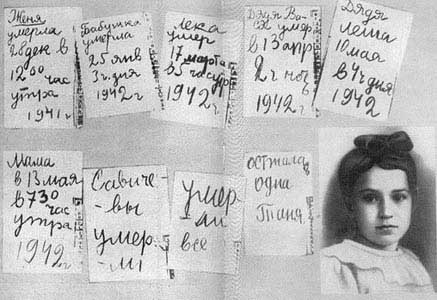
But whereas Anne’s diary is a carefully kept journal over a period of two years, Tanya’s was little more than a few scribbled lines over six sheets of notepaper.

The Leningrad Siege
Leningrad was in the midst of a devastating 900-day siege that lasted from September 1941 until January 1944. The German army had laid siege to it, bombarded it and cut off all supplies in its attempt to ‘wipe it off the map’, as Hitler had ordered.

On September 12 1941, the largest food warehouse was destroyed and the situation, already severe, became critical.

As the Lake Ladoga, to the east of the city, froze, supplies came through by convoys of trucks, a hazardous journey over thin ice and through enemy bombardment. What was brought in, although vital, was only ever a fraction of what was needed.

Within the city, as that first winter progressed, whatever could be eaten had consumed – pets, livestock, birds, vermin. And whatever could be burnt had been. Tanya had kept a diary but this, as with every other book in the household, had been used for fuel.

Tanya, her mother and her five siblings, in common with every citizen of Leningrad, suffered terribly from hunger and cold. One by one, members of Tanya’s family died, and it was recording of each death that constituted the notebook.

Evacuation
Tanya herself was eventually evacuated out of the city in August 1942, along with about 150 other children, to a village called Shatki. But whilst most of the others recovered and lived, Tanya, already too ill, died of tuberculosis on July 1, 1944.

Her notebook was presented as evidence of Nazi terror at the post-war Nuremberg Trials, and today is on display at the History Museum in St. Petersburg.

The text of Tanya’s notebook reads as follows:

Zhenya died on Dec. 28th at 12:30 P.M. 1941

Grandma died on Jan. 25th 3:00 P.M. 1942

Leka died on March 5th at 5:00 A.M. 1942

Uncle Vasya died on Apr. 13th at 2:00 after midnight 1942

Uncle Lesha on May 10th at 4:00 P.M. 1942

Mother on May 13th at 7:30 A.M. 1942

Savichevs died.

Everyone died.

Only Tanya is left.


Rupert Colley
Read all about World War Two in just one hour at historyinanhour.com

Wednesday, 16 December 2009

Battle of the Bulge

World War Two. 65 years ago today (December 16, 1944) saw the start of the German 'Ardennes Offensive' (the Battle of the Bulge). The Allied forces were advancing towards Germany, pushing the Germans back town by town and this was Hitler's last attempt to stop the momentum. The aim was to cut the Allied armies in two and then push on towards the port of Antwerp, a vital Allied stronghold.

"Nuts"
Heavy fog prevented the Americans from employing airpower and the German advance forced a dent in the American line (hence battle of the 'Bulge'). Germans, dressed in American uniforms and driving captured US jeeps, caused confusion and within five days the Germans had surrounded almost 20,000 Americans at the crossroads of Bastogne. When the German commander gave his American equivalent, Major-General Anthony McAuliffe, the chance to surrender, McAuliffe answered with just the one word - "Nuts."

The bursting of the Bulge
Near Christmas the fog lifted, the Americans launched their planes, the Germans ran out of fuel and the bulge was burst. The Ardennes Offensive did delay the Allied advance but by January 28 the line was back to where it was on December 16. The march on Berlin was back on.

The struggle and conditions at Bastogne are brought to life in the excellent US TV series Band of Brothers. There was also a 1965 film starring Henry Fonda and Terry Savalas, "The Battle of the Bulge", a classic American epic where sometimes, it has to be said, historical accuracy took second place to entertainment but none the worse for that!

Rupert Colley.
Read all about World War Two at historyinanhour.com

Monday, 7 December 2009

The Day of Infamy

A good day, I think, to start a historical blog - December 7th, the 68th anniversary of the attack on Pearl Harbor, the attack that brought the USA into World War Two.

It was 7 a.m., a Sunday morning, when the radar station on the island of Oahu first reported to its HQ a number of aircraft on its screen. The reply came back: "Don't worry about it." HQ were expecting a squadron of US planes to be passing by. But these were Japanese planes (bombers, dive-bombers and fighters), 185 of them, intent on ripping out the heart of the US fleet quietly moored on this Pacific island, 3,400 miles away from Japan.

Within a couple of hours it was over - three of the eight American battleships sunk, many other vessels and almost 300 planes. 2,403 Americans died (civilian and military) and over 1,000 wounded. The Japanese lost 29 planes and 100 pilots.

On the same day the Japanese attacked the Philippines and the British colony on Hong Kong.

A Day of Infamy
December 7 was, said US president, Franklin D. Roosevelt, the following day "a date that will live in infamy" and Congress accordingly voted 470 to 1 to go to war (the one being a pacifist vote from Montana).

The USA had entered World War Two and Churchill was delighted. "To have the United States at our side" (he later wrote), "was to me the greatest joy... Hitler's fate was sealed."

But Hitler too was pleased, the teetotaler toasting the occasion with a small glass of champagne. Three days later, on December 11, Hitler declared war on the USA. The conflict, that had started 27 months before, was now truly global.

Rupert Colley
Read all about World War Two in just one hour at historyinanhour.com